






Main categories, Queue barriers, Display systems
How many queue barrier posts do you need? A simple way to count

This guide shows how to count posts and belt sections when organising queues, entrances and barriers. Simple maths is enough: measure the length, choose the segment length and plug it into the formula.
The basic rule for counting posts
You compare the total length L with the length of a single section S. The value of S depends on the chosen product: 150 cm for braided and velour ropes, 225 cm for the white barrier post with 225 cm belt, and 220 cm for the wall head with black belt. Then calculate Nseg = ceil(L / S), i.e. L divided by S and rounded up, and work out the posts according to the layout. Throughout this guide Nseg means the number of sections and Nposts the number of posts.
- Define L as the queue length or zone perimeter
- Choose S, the length of a belt or rope segment
- Calculate Nseg = ceil(L / S) for the number of segments
- Adjust the number of posts to the layout type
How to count posts for a queue
For a straight queue, you count how many S sections fit into the measured length L. For example, with S equal to 150 cm you calculate the number of sections Nseg, and you need Nseg + 1 posts, because each section joins two posts. If you fix one end to the wall with a wall head with black belt, you need one post fewer. Example: the queue is 12 m, i.e. 1200 cm. With 150 cm ropes you get Nseg = ceil(1200 / 150) = 8 sections and 9 posts, or 8 posts with a wall head.
- Measure the queue length L at its longest point
- Choose S: 150 cm (rope), 220 cm (wall head) or 225 cm (belt in a post)
- Nseg = ceil(L / S), Nposts = Nseg + 1 for an open line
- If you use a wall head, subtract 1 post
Counting posts for an entrance
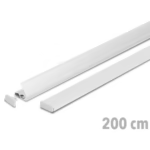
For an entrance, you count the segments needed to close an opening of width W. Divide W by S and round up to get the number of segments. Closing the opening usually takes Nseg + 1 posts. The 150 cm Cafeteria Chrome beam, an accessory for the Cafeteria Set, can serve as a rigid section between posts.
- Measure the entrance width W
- Choose S to cover the opening (150 or 225 cm)
- Nseg = ceil(W / S), posts Nposts = Nseg + 1
- A 150 cm Cafeteria beam can replace a section
Calculating posts for a zone barrier
For a closed zone, it's easiest to count sections along the perimeter P. Divide P by S and round up to get the number of segments. In a closed layout the number of posts equals the number of segments, because the last section joins the start. If a short gap remains, consider another 150 cm element to fit the layout.
- Measure the zone perimeter P
- Choose S, the length of the belt or rope used
- Nseg = ceil(P / S), in a loop Nposts = Nseg
- Mix lengths to avoid short sections
Choosing belts and accessories from our range
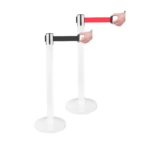
When planning, choose an element that matches the segment length you need. Braided and velour ropes have 150 cm sections, the white barrier post with 225 cm belt gives a longer reach, and the wall head has a 220 cm long, 4.5 cm wide belt. Use these values as S and combine different elements to fit the layout as well as possible.
- Match S to the available products (150 cm, 220 cm, 225 cm)
- Braided and velour ropes are 150 cm long
- The white barrier post with 225 cm belt gives a longer section
- The wall head with 220 cm belt saves one post
Frequently asked questions
How do you quickly count posts for a straight queue?
Measure the queue length L, choose the section length S (e.g. a 150 cm rope or 225 cm belt), and calculate Nseg = ceil(L / S). If you place posts at both ends, you need Nposts = Nseg + 1. With one wall head, subtract one post.
How many posts do I need for a closed zone?
For perimeter P, choose S, the length of the belt or rope, and calculate Nseg = ceil(P / S). In a closed barrier the number of posts equals the number of segments, Nposts = Nseg, because the last segment joins the first.
Is it worth using a wall head instead of a post?
The wall head with black belt has a 220 cm belt and saves one post at the end of a section. It's a good solution when floor space is limited or one end can be fixed to a wall.