




How much energy does an LED lightbox use and what affects running costs?
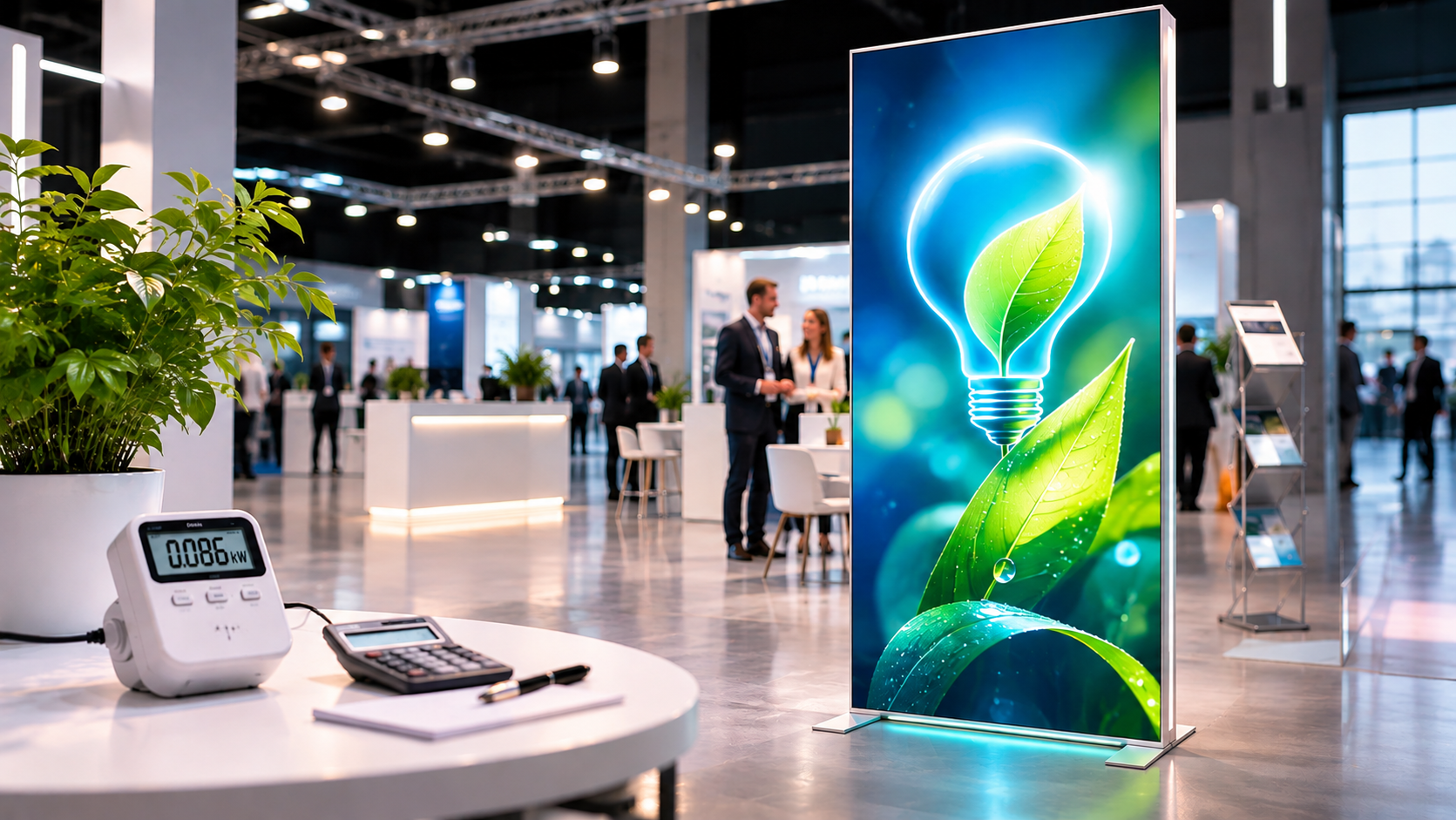
An LED light box draws attention with evenly lit graphics, but it only shines when it has a constant power supply. How much electricity does it use at a trade show, a conference or in an office? That depends on the power of the whole system, how long it is lit, how it is controlled and the conditions it works in.
LED light box energy consumption is something you can work out yourself. You need three figures: the power drawn from the mains, the number of operating hours and the energy rate. At a trade show, also check how the organiser charges. A connection or power access fee may be charged regardless of how much electricity you actually use.
Power is not the same as energy consumption
Power is given in watts (W). It tells you how much energy the light box draws at a given moment. Energy consumption is measured in kilowatt-hours (kWh), and that is usually what you pay for.
So a light box with higher power does not have to cost more over its whole service life. If it is lit for a few hours during an event, it may use less energy than a smaller system that runs every day at a point of sale.
How do you calculate an LED light box's energy consumption?
The formula is simple:
energy consumption in kWh = power in W ÷ 1000 × operating time in hours
Example (figures chosen for the calculation only): the light box draws 120 W in total and is lit for 10 hours a day over a three-day event.
120 ÷ 1000 × 10 × 3 = 3.6 kWh
The cost is this result multiplied by the current rate per 1 kWh. If the trade show organiser provides the power, don't rely only on your home or business tariff. The organiser may charge a flat fee, a separate technical fee or bill power in its own way.
How do you find the real power?
Start with the technical documentation or the label on the power supply. What counts is the draw of the whole set from the mains, not just the sum of the LED modules. The power supply also works and loses some energy.
If the label on the device is unclear, use a plug-in energy meter. Measure during normal operation, once the backlight has stabilised. If the system has brightness control, measure the draw at the setting you use most often.
What does an LED light box's energy consumption depend on?
Two light boxes of a similar size can draw different amounts of power. It comes down to the construction, the number and layout of light sources and the conditions the light box works in.
| Factor | Effect on consumption | What to check before choosing? |
|---|---|---|
| Size of the illuminated area | A larger area usually needs more LED modules or strips. | Compare the power of the whole system, not the frame width. |
| Single- or double-sided backlighting | A second lit side can increase energy use. | Will both sides really be visible? |
| Brightness | Higher brightness usually means higher power draw. | Does the system have brightness control? |
| Operating time | Every hour it is lit means more kWh used. | List the lit hours for each day of the event. |
| Power supply | Its efficiency determines how much energy the set draws from the socket. | Take the parameters of the whole set into account. |
| Technical condition | Damage can cause uneven operation and spoil the look of the display. | Before leaving, check the cables, connections and backlighting. |
Light box size and density of light sources
The larger the graphic, the larger the area that has to be lit evenly. What matters is not just the number of LEDs but also their layout, distance from the fabric and the profile design. A well-designed layout reduces bright spots and darker patches on the graphic.
Don't choose a light box only on the stated number of light sources. Two different layouts with a similar power draw can give a different effect. Judge the whole thing: frame, graphic, power supply and how the light is diffused.
One or two lit sides?
A light box placed in open space can show a graphic on both sides. This is useful on an island stand, in a walkway or at an entrance area. Against a wall, a second lit side may be unnecessary.
Before ordering, work out where visitors will look at the display from. That way you won't order elements you won't use.
Brightness and ambient lighting
In a bright hall a light box competes with ceiling lights, screens and other exhibitors' spotlights. In a showroom or conference room full power may be unnecessary. If the system has brightness control, you can match the backlighting to the venue.
Before dimming the light box, check how it looks with the finished graphic. Dark colours, large solid areas and small design details can look different when backlit. Set the brightness so the graphic stays legible. Saving power shouldn't come at its expense.
What makes up the running cost?
The electricity bill is only part of the cost. Add organising the power supply, transport, graphic changes and any servicing.
- Electricity: depends on power draw, operating time and how it is billed.
- Power access: at trade shows it is often a separate item ordered from the organiser.
- Transport: depends among other things on the number of elements, their format and packaging.
- Graphic changes: let you use the same frame in later campaigns.
- Maintenance and repairs: cover power supplies, cables, connections and light sources.
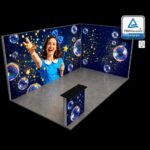
At a trade show, add up the power of all devices on the stand, because the light box is usually not the only load. There are also monitors, laptops, chargers, lighting and equipment used by staff. If you choose a complete build such as the Fastframe™ 12 m² exhibition stand, include every piece of equipment that needs power in the total.
How can you cut costs without spoiling the display?
- Set the lighting hours. Switch the light box on before the event opens and off when it ends. Don't leave it on overnight unnecessarily.
- Adjust the brightness. If the frame has a dimmer, set the level to suit the light in the hall or room.
- Count the whole set. Add up the power of light boxes, spotlights and other devices so you order the right power supply.
- Light only the visible sides. A second active side achieves nothing if it is covered the whole time.
- Check the connections. Loose cables and damaged parts can disrupt the system.
- Do a test before the event. Check the backlighting, graphic and power before you pack the light box for transport.
How you assemble the frame affects its stability, cable safety and whether the graphic looks even. You'll find practical tips in the guide on how to carry out fabric wall assembly and avoid typical light box mistakes.
How do you plan the power supply for a light box at a trade show?
Start with a list of devices. For each, note the power, planned operating time and which will run at the same time. With such a table it is easier to talk to the organiser and harder to order the wrong connection.
Check where the socket is in relation to the frame. A cable running across a walkway must be properly secured. If you want to mount extra lights on the frame, you may need a matching part such as a lighting bracket for Formulate and Modulate™ frames. Enter these lights in the power total as a separate item.
The result also depends on how the light box is assembled: tensioning the graphic, joining the frame and routing the cables. Before first use, read the description of the most common mistakes when assembling light boxes.
FAQ
Does a bigger LED light box always use more energy?
Not always. The backlight design, number of light sources, power supply and brightness setting also matter. Compare the mains draw of the whole system.
Does switching the light box off during breaks reduce costs?
Yes, if you pay for the energy actually used. With a flat trade show fee the amount paid to the organiser may not change, but the components still run for less time.
Can you calculate the cost without an energy meter?
Yes. You only need the power of the whole set, the operating time and the current rate per kWh. A meter is useful when you want to check the actual draw in a specific configuration.
Does the graphic affect power draw?
With the same settings the graphic itself usually doesn't change the draw. It may, however, affect the brightness you choose: a dark design may need a different setting than a light one.
Should the light box be lit for the whole trade show day?
Usually yes, if it is an important part of the stand's identity. Outside event hours there is no need to leave it on, unless the organiser requires otherwise.
Summary
An LED light box's energy consumption is the power drawn from the mains multiplied by the operating time. The cost is also affected by how power is billed, the number of lit sides, brightness, the power supply and other devices on the stand. The most reliable way to work it out is from the system documentation or by measuring the finished set.
Planning a trade show, a conference or a permanent display? Contact Maxi Expo. We'll help you choose a display system for your space, use and budget, taking backlighting, transport and graphic changes into account.