





Which advertising flag should you choose for a trade show, event or outside your premises?
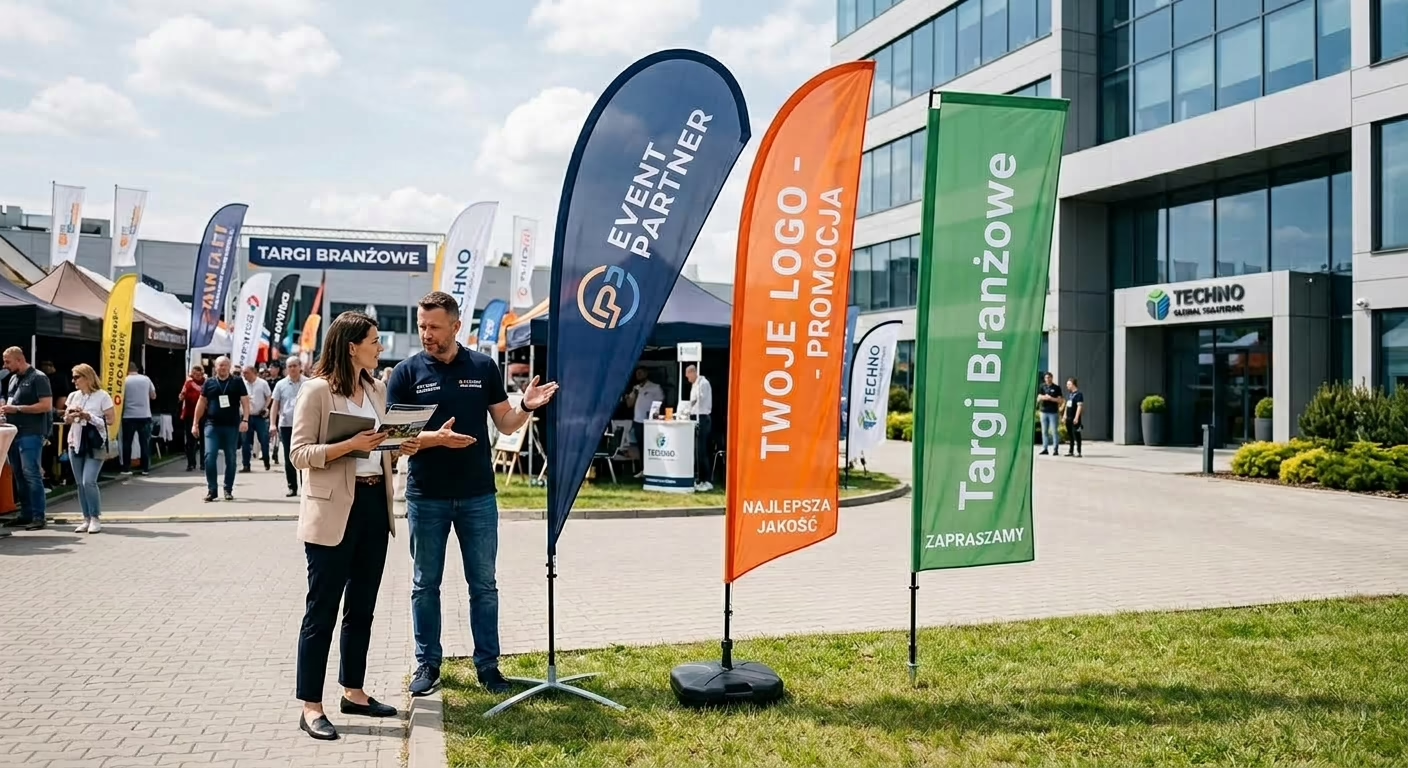
An advertising flag can mark an entrance, highlight a stand, guide attendees to a specific area or increase the visibility of company premises. It's mobile, relatively easy to set up and works well both on its own and in a larger arrangement. But to do its job, it must suit the location, how it will be used and the graphic design.
How to choose an advertising flagthat will be practical and legible? First decide where it will stand, from what distance it should be visible and how often it will be transported. Only then choose the shape, height, base and type of print.
Where should you start when choosing an advertising flag?
The most common mistake is choosing a flag based on looks alone. An attractive shape matters, but it doesn't answer questions about stability, mounting, storage or graphic legibility.
Before ordering, it's worth preparing a short brief:
- display location: exhibition hall, outdoors, pavement, car park, building entrance, wall or lamp post;
- goal: building awareness, showing the way, promoting an offer or marking a specific area;
- period of use: a one-off campaign, a series of events or a permanent display;
- mobility: frequent transport by the team or installation in one place;
- available space: walkway width, room height and the space needed for the base;
- surroundings: other advertising displays, architectural features, foot traffic and entrance visibility.
This information helps you avoid a flag that is too big for the stand, a base that gets in the way, or a message that is illegible from where people look.
A flag for a trade show, an event or outside your premises: how do the needs differ?
An advertising flag for trade shows
In an exhibition hall a flag usually marks the stand or serves as a landmark. It should fit the exhibitor's whole identity: wall, counter, printed materials and screens. The limits set by the stand area and the organiser's rules are important.
In a small space it's better to go for a simple message and a slim system that won't hide staff or products. Before choosing a tall model, check the maximum build height and the position of the hall's technical fixtures. The flag also shouldn't stick out beyond the rented area or narrow the walkway.
A flag for an outdoor event
At an outdoor event visibility matters, but so does how the system can be set up on the ground in question. A lawn may need a different base from a paved square, and different again from a place where the surface can't be disturbed.
Changing weather must also be considered. The system should be used according to the manufacturer's recommendations, and its stability checked regularly. If the weather worsens, take the display down rather than assume every flag is designed to work in any conditions.
A flag outside your premises
Outside an office, store, service point or warehouse a flag can act as a year-round signpost or carry a temporary campaign. For this use, consider visibility from the street and car park, the space available and how the system will be secured after hours.
If the message is to be seen by drivers or people further from the building, it should be extremely short. The brand name, a distinctive colour and a simple direction often work better than a list of services in small print.
The key criteria for choosing an advertising flag
| Criterion | What should you check? | Why does it matter? |
|---|---|---|
| Location | Indoors or outdoors, type of ground, available height and width | Affects the choice of structure and base |
| Viewing distance | Whether the flag will be seen from a few steps, from the aisle or from the road | Determines the logo size and message length |
| Mobility | How often it is transported, set up and stored | Helps choose a system that is convenient for the team |
| Ground | Grass, soil, paving, asphalt, hall floor or a vertical surface | Determines the possible mounting method |
| Surroundings | Foot traffic, walkways, doors, vehicles and neighbouring advertising | Affects safety and visibility |
| Graphic | Logo, colours, slogan and reading direction | Determines how legible the message is |
Flag shape
The shape affects the character of the display and how the graphic is laid out. Flags with a dynamic, elongated form attract attention well and can emphasise the event feel of the message. Models with a larger area at the top make it easier to give strong prominence to the brand mark or a short slogan.
An example of a versatile solution for events, trade shows and outdoor use is the Zoom Feather advertising flag. An alternative with a different outline is the Zoom Crest advertising flag with print. The choice between them should take into account the design, the space available and the planned character of the display, not just personal preference.
Height and scale of the display
A bigger flag doesn't always mean a better result. On a small stand it can dominate the layout, and in a low room it simply may not fit. On the other hand, in front of a large building a display that is too small can disappear against the facade and surroundings.
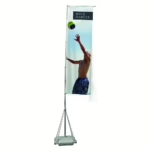
If the goal is a striking point visible from further away, you can consider a large-scale system such as the Wind Dancer 5 m advertising flag. Before choosing it, however, assess the location, the space needed for set-up and compliance with the rules that apply at the event or site.
Type of base and mounting method
The base must suit the surface and the purpose of the system. In a hall, stability matters most, along with placing it so it doesn't become an obstacle for visitors. Outdoors, consider the type of ground and whether a solution designed for that surface can be used.
Not every system has to be free-standing. Mistral flag is designed for mounting on lamp posts and walls, so it can work well for marking events or a brand in public spaces. Such mounting does, however, require confirming the technical feasibility first and obtaining the necessary permission from the property owner or site manager.
How often it is transported
If the flag travels with the team to many events, it's not only about how it looks once set up. Ask about how it folds, the number of parts, the transport packaging and how easy it is to set up. A well-chosen system reduces the risk of losing parts and speeds up stand preparation.
For campaigns on the move or promotional activities of a different kind, you can also look at the Street Flag with print. Every mobile solution should be matched to the campaign scenario and the comfort of the person who will use it.
How do you design an effective flag print?
A flag has a relatively narrow and unusual surface, so don't transfer a leaflet or detailed poster design onto it. People often see it briefly, from a distance or while moving.
An effective design should follow a few rules:
- one main piece of information: ideally the brand name, logo or a short slogan;
- a clear hierarchy: the most important element should be seen first;
- contrast: text and logo must stand out from the background;
- a limited number of elements: too many icons, photos and words make it harder to take in;
- safe placement: key parts of the design shouldn't fall where the flag shape or structure may distort them;
- brand consistency: colours and typography should match the company's other materials.
Before printing, look at the design not only on a monitor but also scaled down. If the logo or slogan becomes illegible in a small preview, it may not catch attention quickly enough in a real environment full of distractions.
One flag or a set of several?
A single flag works well at an entrance, next to a counter or to mark a chosen point. Several identical displays, on the other hand, can mark a route, emphasise the boundaries of a zone or create a rhythmic display outside a building.
With a set, be consistent. The flags can repeat one message or present an ordered sequence, for example the brand, a product category and the direction to go. But don't split one sentence across several displays if people can't be sure in what order they'll see them.
Flags and other advertising systems
A flag works best as part of a consistent display. On a stand it can lead the eye to the wall and counter, and outdoors it can point to where the main message is. It won't always replace a display designed to present more information.
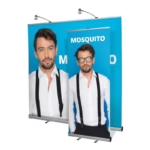
If you need a vertical, orderly graphic with more detailed content, a good complement can be the Mantis roll-up. For outdoor use, consider a system designed for that environment, e.g. the Thunder 2 outdoor roll-up. The final set should follow from the location, the communication goal and the budget available.
The most common mistakes when choosing an advertising flag
- No site analysis. Ordering a system without checking the height, walkway width and type of surface can make set-up difficult.
- Too much text. A flag isn't a catalogue. A long description of the offer usually can't be read on the move.
- The wrong base. The same set-up won't necessarily work on a hall floor, a lawn and a car park.
- Ignoring the event rules. The organiser may set rules on height, stand boundaries and the installation of advertising elements.
- A random graphic. A design disconnected from the visual identity weakens brand recognition.
- No plan for transport and storage. Even a simple system needs proper protection between events.
FAQ: choosing an advertising flag
Which advertising flag works best at trade shows?
The best one is a model matched to the stand area, the maximum height and how visitors move around. On a small stand, choose a slim structure and a simple graphic that won't hide the other display elements.
Can the same flag be used indoors and outdoors?
That depends on the specific system, the available bases and the manufacturer's recommendations. Before buying, confirm what the structure is designed for and choose a mounting method to suit the surface and conditions of use.
How much text should you put on a flag?
It's best to limit the content to the logo, brand name and one short slogan. If the flag is meant to show the way, the message should be even simpler and include a clear direction marker.
Can a flag stand outside a company all year round?
Whether long-term display is possible depends on the model, the mounting location, the weather and how it is used. The system needs regular checks, and the print should be cleaned and stored according to the recommendations for the product.
Is it better to order one large flag or several smaller ones?
One larger flag can create a strong landmark, while several smaller ones help mark a route or the boundaries of a zone. Decide after checking the viewing distance, the space available and the purpose of the display.
How to choose an advertising flag: summary
A well-chosen flag combines visibility, practical set-up and a simple message. Before ordering, define the display location, viewing distance, type of ground, how often it will be transported and the flag's role in the overall layout. Then match the shape, scale, base and graphic design.
A flag is part of the whole display. Combined consistently with a wall, a roll-up, a counter or directional signage, it helps create a professional, easily recognisable space.
Contact Maxi Expo to choose a display system matched to your event, space and budget. Our team will help you choose a solution and take care of large-format printing and transport.