



Main categories, Queue barriers, Display systems
Belt post or rope: how to choose a barrier system?

The choice between a post with a belt and a connected rope depends on the function and look of the line. Below we compare the solutions in the Maxi Expo range and suggest how to combine them.
When to choose posts with a retractable belt
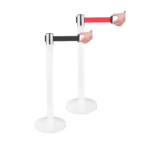
Posts with a belt are a good choice where quick set-up and adjusting the queue matter. The white barrier post with 225 cm belt allows longer sections between posts, and the wall head with 220 cm black belt works well against a wall when space is short. A belt makes it easy to mark clear traffic lines.
- The long 225 cm belt reach makes it easy to create lines.
- The belt in the wall head is 220 cm long.
- Retractable belts make changing the layout simple.
- With long belts you need fewer posts.
Where rope or cord systems work well
Ropes and cords are an attractive, stable solution for shorter sections between posts. Ropes, for example the black braided one with chrome clip or the red velour one with gold clip, are 150 cm long and 2.8 cm in diameter. Thanks to the fixed length, the whole line looks uniform.
- The standard rope length is 150 cm.
- The rope diameter is ø 2.8 cm.
- Braided and velour versions available.
- Designed for ROYAL and MODERN posts.
Finish and fit with the interior
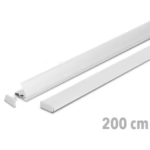
Looks often decide between a belt and a rope. A velour rope, for example black with a gold clip, emphasises the prestigious character of an entrance. A braided rope looks more formal, especially with a chrome clip. Cafeteria beams, chrome and gold, extend the Cafeteria Set and stabilise a mounted graphic.
- Velour ropes give a prestigious look.
- A chrome clip suits silver posts.
- A gold clip goes with gold posts.
- The Cafeteria beam stabilises the mounted graphic.
Practical tips for connecting posts
When connecting posts into a line, pay attention to element lengths: belts are 225 cm and 220 cm, ropes 150 cm. Uneven sections require extra posts or careful routing. The white barrier post with 225 cm belt weighs about 7.5 kg, of which the base alone is 6.5 kg, which helps keep the line stable.
- Adjust the spacing to the belt and rope length.
- Use clips that match the post finish.
- A heavy post base increases stability.
- Snap hooks make fitting easier.
Storing and handling the systems
When planning transport and storage, three parameters are useful: the weight of a single item, the number of pieces in a bulk pack and the number of pieces per pallet. Below we list them for ropes and Cafeteria beams.
- A braided rope weighs 0.70 kg, a velour one 0.60 kg.
- A bulk pack holds 30 pieces: 22 kg for braided, 19 kg for velour.
- The Cafeteria beam weighs 0.9 kg and is 150 cm long.
- A Euro pallet holds a maximum of 180 pieces.
Frequently asked questions
Does a belt reach further than a rope?
Yes. The white barrier post with 225 cm belt has a longer reach than typical 150 cm ropes. The wall head with black belt has 220 cm of belt, which is also more than a standard rope.
Will a rope fit my post?
Braided and velour ropes are designed for ROYAL and MODERN posts. Choose a clip in a finish that matches the post colour, for example a gold clip for gold posts.
How do you match finishes and colours when connecting?
Match the clips and rope colours to the post finish. Versions with a chrome clip suit silver posts, and gold clips suit gold-finish posts.